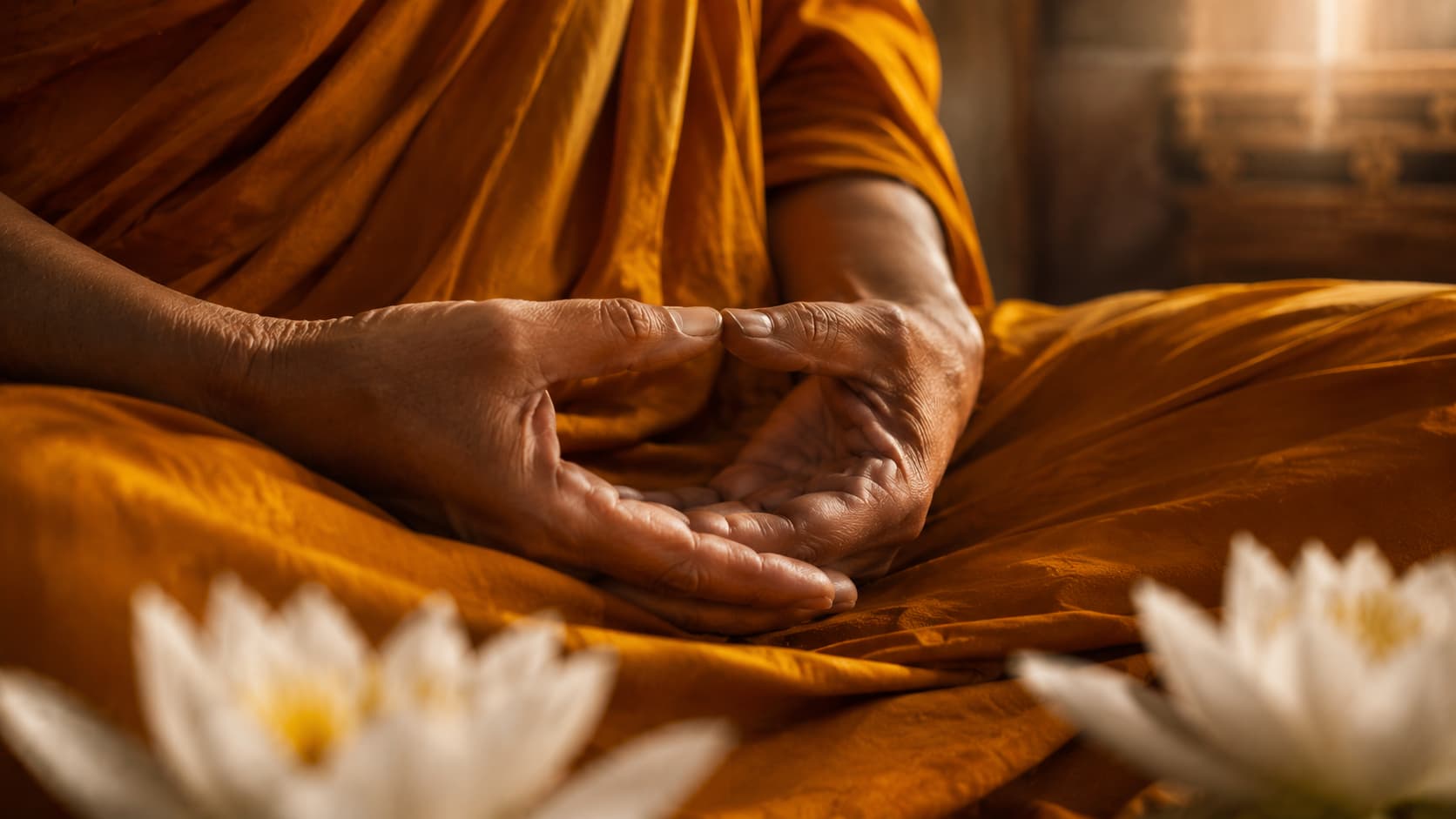
Walk into any Buddhist temple, and the very first thing you are likely to notice is the hands. Every Buddha statue, every sacred painting, and every meditating monk holds their hands in a specific, deliberate way.
These are not random poses. Each hand position carries a name, a story, and a deep spiritual meaning passed down for over 2,500 years. Known as mudras, Buddhist hand gestures form a rich visual language that communicates wisdom, compassion, protection, and enlightenment.
This guide covers the key mudras, their meanings, their traditions, and how to bring them into your own meditation practice.
What Are Buddhist Hand Signs?
Buddhist hand signs, formally known as mudras, are symbolic gestures used across Buddhist art, iconography, ritual, and meditation.
Each deliberate hand position represents a specific spiritual quality, such as compassion, wisdom, fearlessness, or enlightenment, and serves as a visual language that connects the physical body to the inner world of Buddhist teaching and practice.
Rooted in a tradition that stretches back more than 2,500 years to ancient India, these gestures appear on statues and sacred paintings throughout Asia and are still practiced by meditators and monks as living expressions of the Buddha’s teachings rather than mere decorative poses.
What Each Finger Represents in Buddhist Symbolism
Before exploring individual mudras, it helps to understand the symbolic meaning behind each finger in Buddhist tradition.
The hands are not just physical instruments in this system. They are a map of consciousness, the elements, and spiritual qualities, and knowing what each finger represents helps you read any mudra with greater depth.
The Five Fingers and Their Symbolic Meaning:
| Finger | Element | Symbolic Meaning |
|---|---|---|
| Thumb | Space | Universal consciousness, the Buddha principle |
| Index finger | Air | Individual consciousness, the practitioner |
| Middle finger | Fire | Patience, transformation |
| Ring finger | Earth | Wisdom, stability |
| Little finger | Water | Compassion, flowing awareness |
The Right Hand vs. the Left Hand in Buddhism
In Buddhist iconography and practice, the right hand typically represents active compassion and engagement with the world, while the left hand symbolizes inner wisdom and the meditative state.
When two hands come together in a mudra, they often represent the union of these two principles: skillful action and deep wisdom functioning as one.
10 Buddhist Hand Signs and Their Meanings
These ten mudras appear most consistently across Buddhist art, temple iconography, and meditation practice worldwide. Learning them gives you a meaningful way to read sacred art and deepen your own practice.
1. Dhyana Mudra (The Meditation Seal)
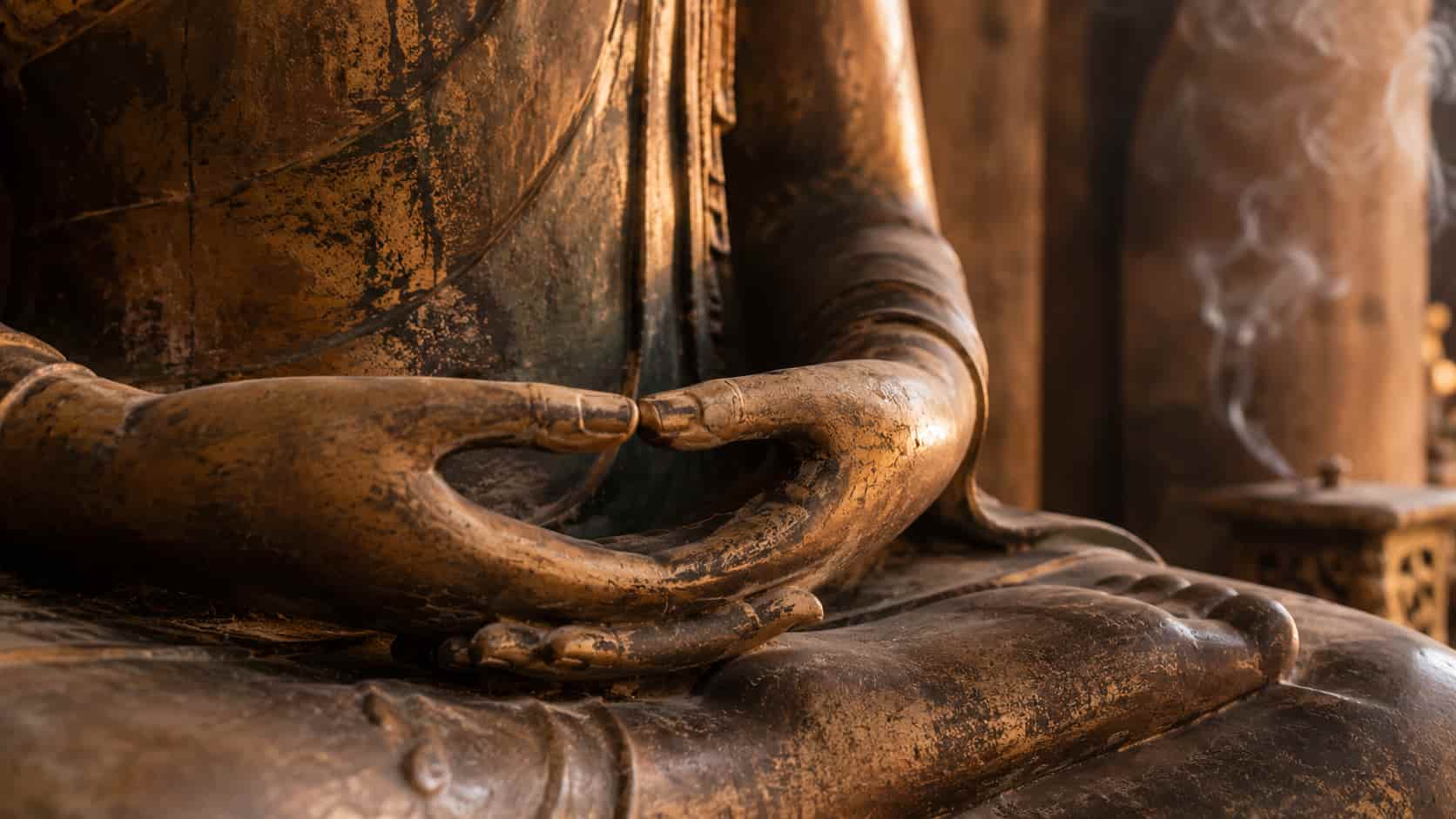
One of the most universally recognized Buddhist hand signs, the Dhyana Mudra represents the stillness of deep meditation. It is directly linked to the Buddha’s state of mind at the moment of enlightenment.
- How to identify it: Both hands rest in the lap, palms facing upward, right hand over left, thumb tips lightly touching to form an oval.
- What it means: Deep meditation, inner concentration, and complete equanimity.
- Where you see it: Seated Buddha statues across Theravada temples in Thailand, Sri Lanka, and Cambodia; associated with Amitabha Buddha in the Mahayana tradition.
- How to practice it: Rest both hands palm-up in the lap during seated meditation, thumbtips lightly connected, arms fully relaxed.
2. Bhumisparsha Mudra (The Earth-Touching Gesture)
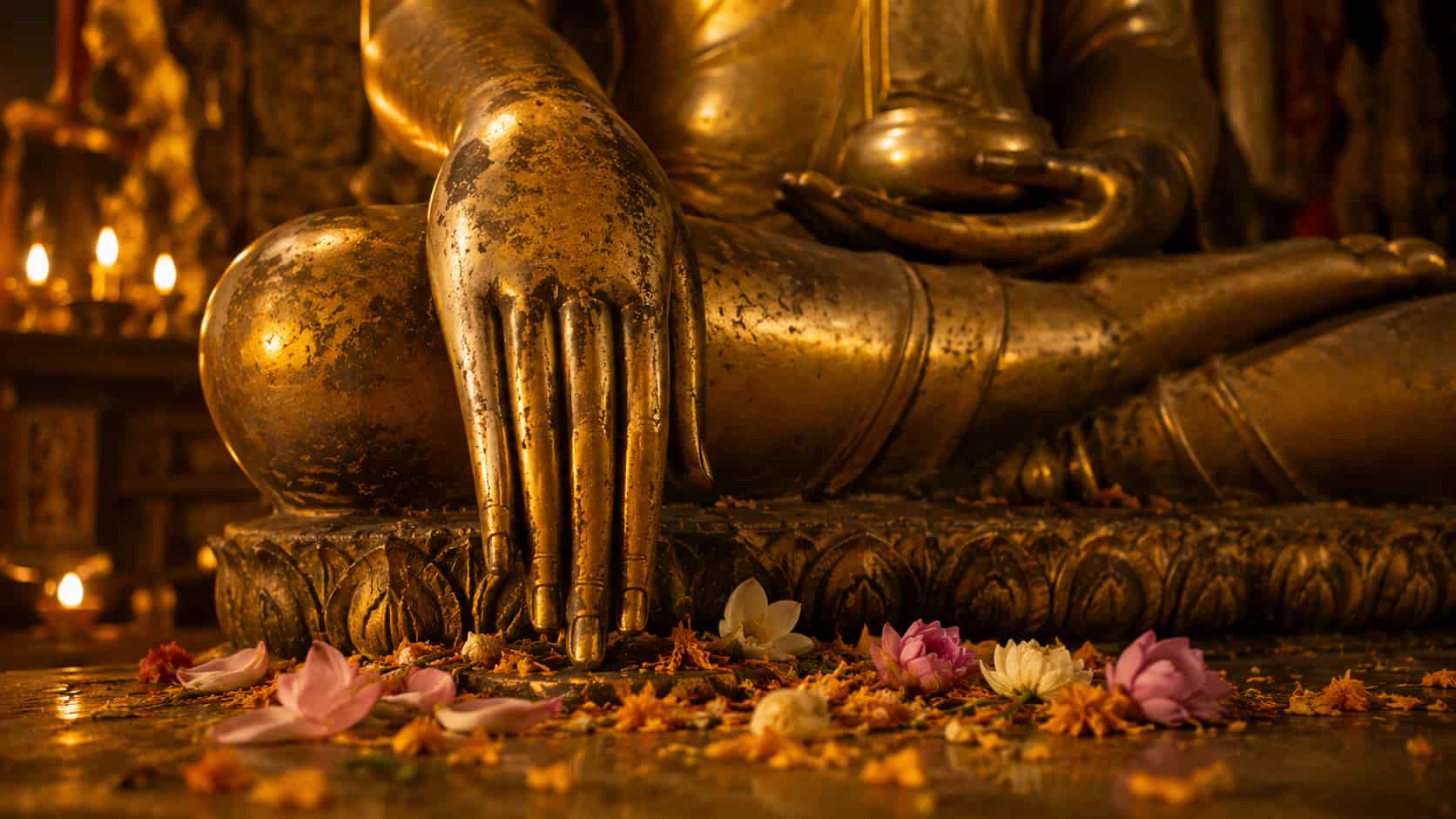
This mudra captures the single most important moment in Buddhist history: the Buddha’s enlightenment under the Bodhi tree. It communicates unshakeable resolve and the total defeat of inner obstacles.
- How to identify it: Right hand rests on the right knee, fingers pointing downward toward the earth; left hand rests palm-up in the lap.
- What it means: Calling the earth to witness enlightenment; steadfastness, truth, and the overcoming of temptation.
- Where you see it: Among the most common mudras on statues throughout Southeast Asia; associated with Akshobhya Buddha in the Vajrayana tradition.
3. Abhaya Mudra (The Gesture of Fearlessness)
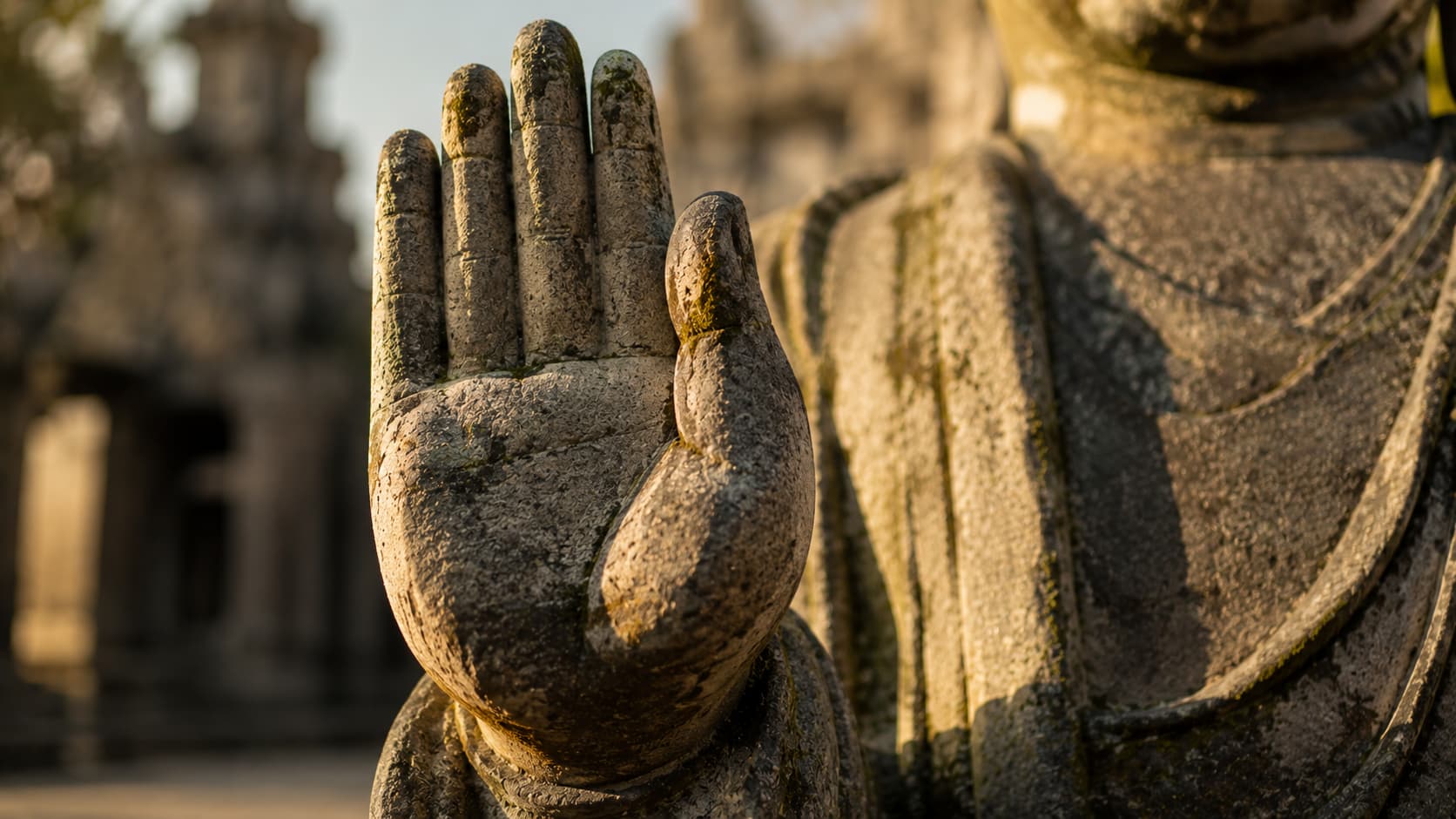
Seen most often on standing and walking Buddha statues across Asia, this mudra is a visual promise of safety. It is the Buddha communicating, without words: there is nothing to fear on this path.
- How to identify it: Right hand raised to shoulder height, palm facing outward, fingers pointing upward; left hand rests at the side or in the lap.
- What it means: Protection, reassurance, and the removal of fear along the Dharma path.
- Where you see it: Standing and walking Buddha statues in Thailand, Myanmar, and Cambodia.
- How to practice it: Raise the right hand with palm outward at the start of walking meditation as an intention of calm and openness.
4. Varada Mudra (The Gesture of Giving)
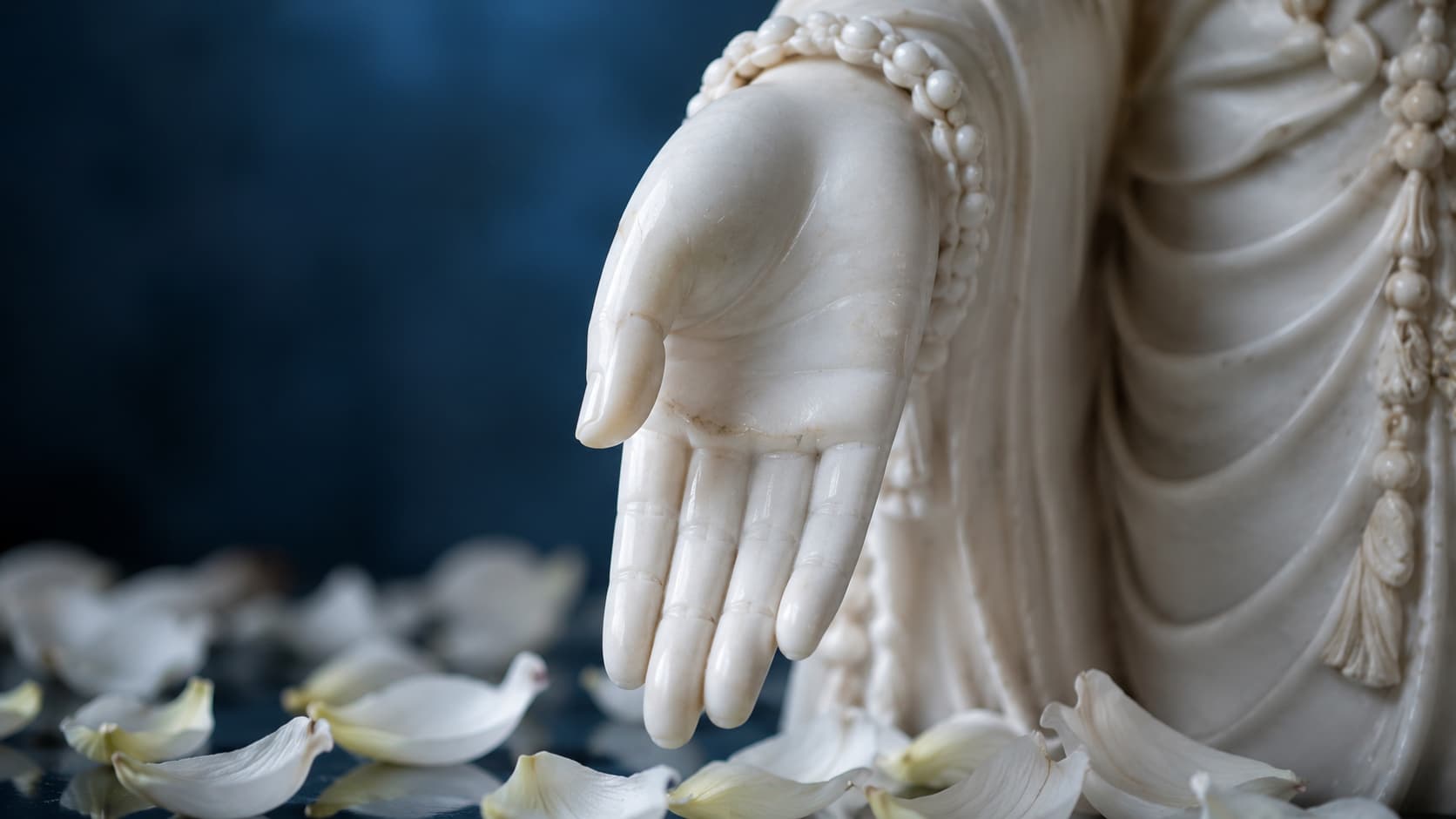
The Varada Mudra speaks directly to dana, the Buddhist virtue of unconditional generosity. Its open, downward-facing palm is a universal visual signal of offering without expectation.
- How to identify it: One hand (usually the left) extended downward, palm facing outward, fingers pointing toward the ground; often paired with the Abhaya Mudra in the opposite hand.
- What it means: Charity, compassion, and the Buddha freely offering the Dharma to all beings.
- Where you see it: Standing Bodhisattva figures, especially Guanyin (Kuan Yin); Theravada temple statues across South and Southeast Asia.
5. Dharmachakra Mudra (The Wheel-Turning Gesture)
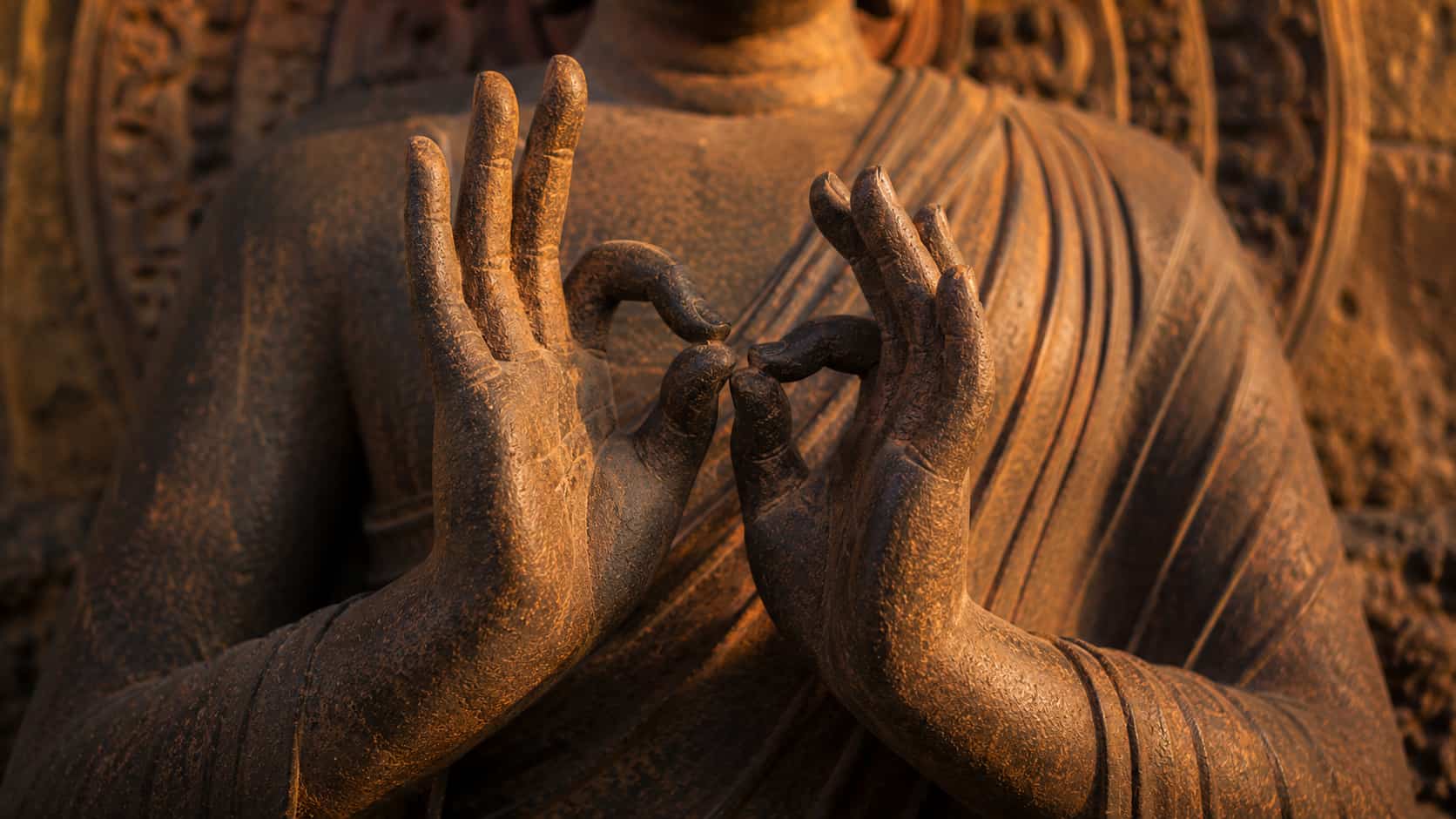
This mudra marks the moment Buddhism began as a living tradition: the Buddha’s first sermon at Deer Park in Sarnath. It is the gesture of the Dharma being set in motion for the world.
- How to identify it: Both hands held at chest level; thumbs and index fingers of each hand form circles, right facing outward, left facing inward, with the tips lightly touching.
- What it means: The first turning of the Dharma wheel; transmission of wisdom and the origin of Buddhist teaching.
- Where you see it: Gandharan and Gupta-period Buddhist art; prominently associated with the Vairochana Buddha in the Mahayana tradition.
6. Vitarka Mudra (The Gesture of Teaching)
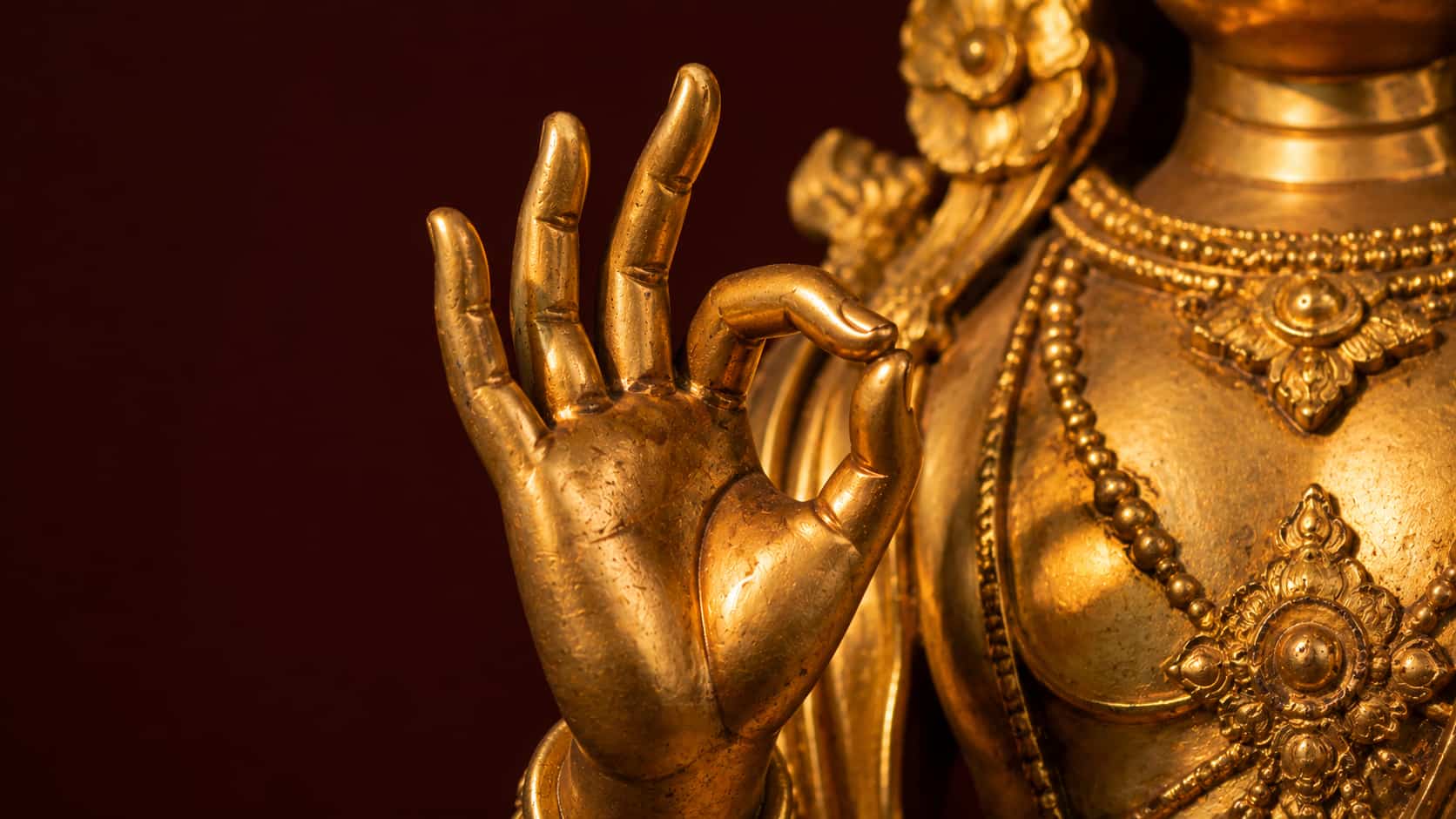
Similar in form to the Dharmachakra Mudra but carrying a different meaning, the Vitarka Mudra refers to any ongoing moment of instruction rather than to that original, world-changing first sermon.
- How to identify it: One hand (or both) raised with thumb and index finger forming a circle; remaining three fingers extended upward.
- What it means: Active transmission of a specific teaching; ongoing spiritual instruction.
- Key distinction from Dharmachakra: Uses one hand, refers to the continuing act of teaching rather than the first sermon.
- Where you see it: Bodhisattva figures and teaching Buddhas across Chinese, Japanese, and Tibetan Buddhist art.
7. Anjali Mudra (The Prayer Gesture)
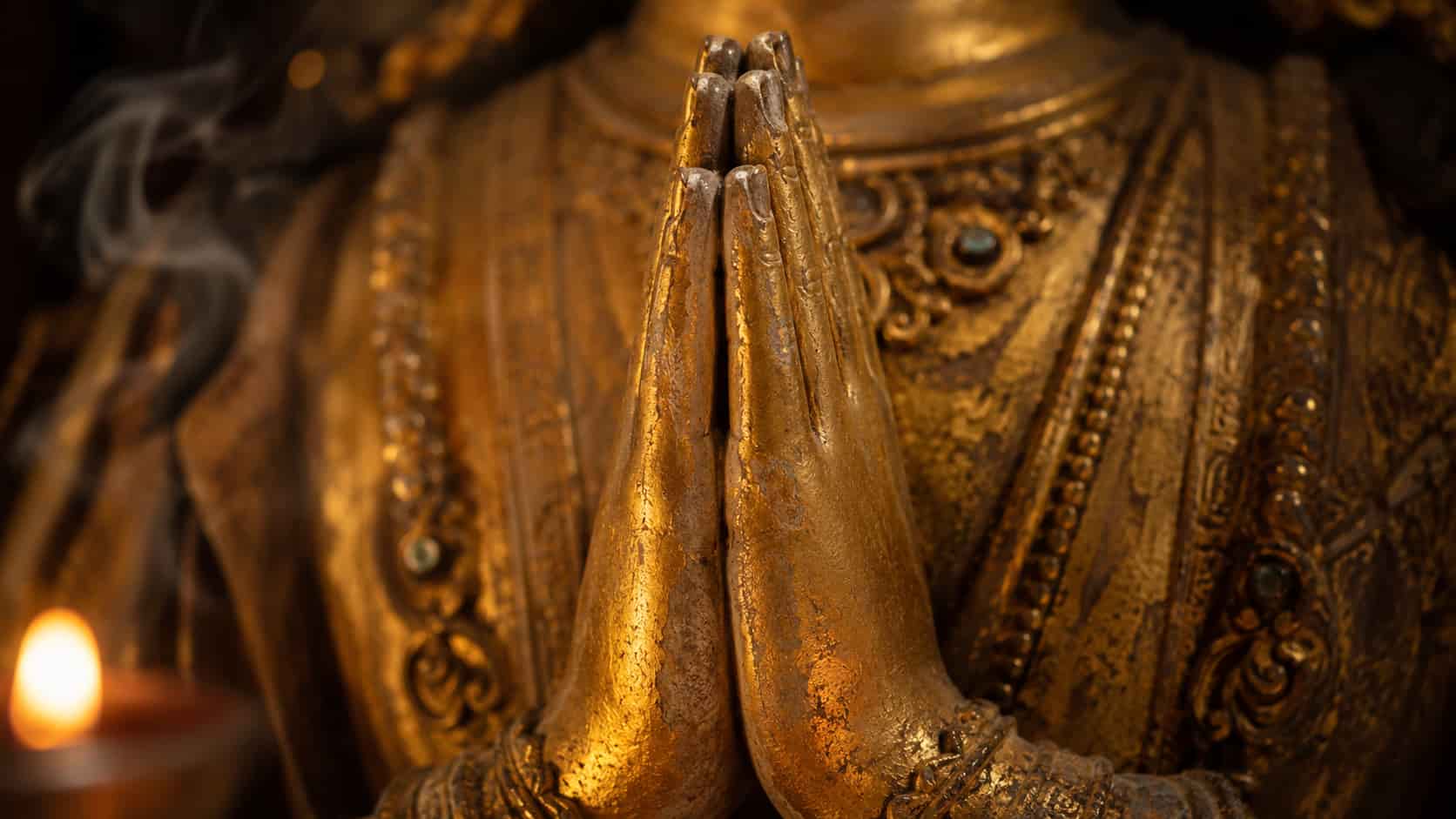
The most universally recognized of all Buddhist hand signs, the Anjali Mudra appears equally in daily temple life, formal ritual, and seated meditation practice across every Buddhist tradition.
- How to identify it: Both palms pressed together at the chest or forehead, fingers pointing upward. Called Gassho in Japan, Wai in Thailand.
- What it means: Reverence, gratitude, and recognition of the sacred; the union of wisdom and compassion in the joined hands.
- Where you see it: All Buddhist traditions; mirrored in Hindu Namaste and everyday Southeast Asian social customs.
- How to practice it: Use it at the opening and closing of every meditation session to mark the transition into formal practice.
8. Karana Mudra (The Gesture of Warding Off Evil)
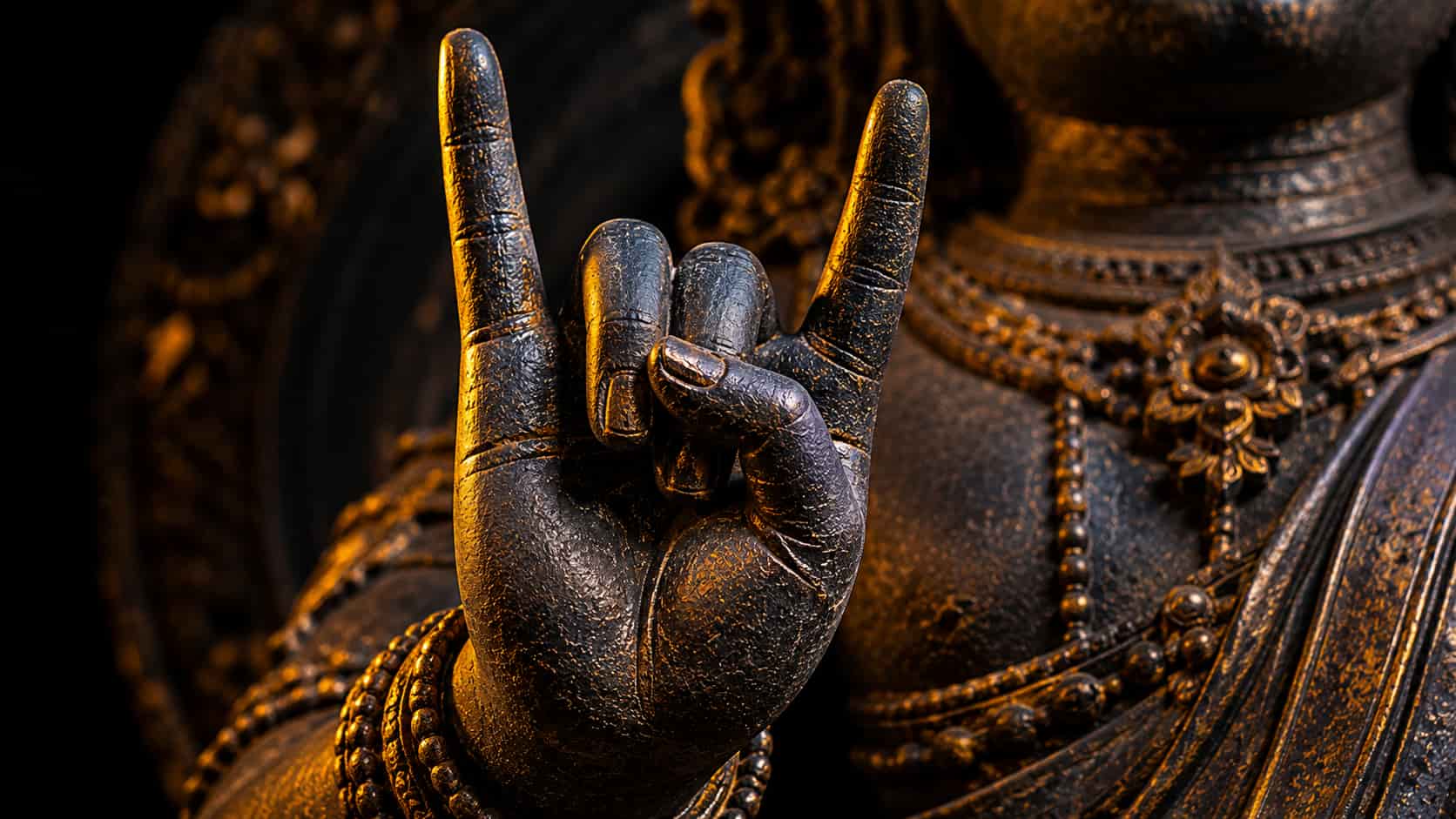
Unlike the other mudras in this guide, the Karana Mudra serves a specifically protective function. It is used to actively dispel obstacles, negative energy, and harmful influences.
- How to identify it: Index finger and little finger extended upward; middle and ring fingers held down by the thumb.
- What it means: Dispelling negative energy, illness, and spiritual obstacles; active protective purification.
- Where you see it: Tibetan Buddhist iconography; Newari Buddhist art from Nepal; tantric ritual ceremonies.
9. Uttarabodhi Mudra (The Gesture of Supreme Enlightenment)
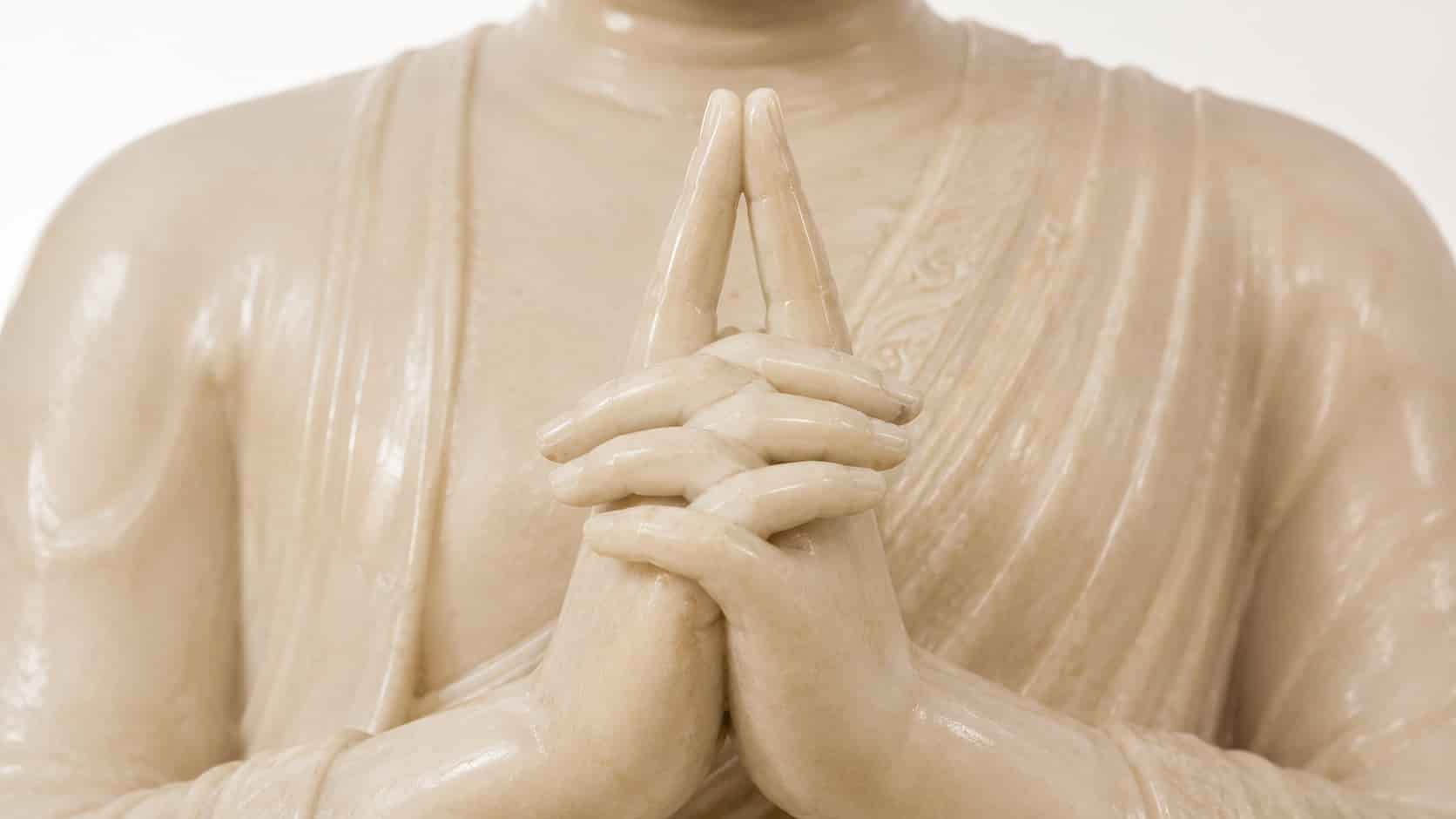
Distinctive for its paired upward-pointing index fingers, this mudra gestures toward the highest possible state of awakening and the merging of the individual mind with universal Buddha-nature.
- How to identify it: Both hands at chest level or raised above the head; index fingers of both hands pressed together, pointing straight upward; remaining fingers interlaced; thumbs crossing each other.
- What it means: Perfect enlightenment; the union of individual consciousness with universal Buddha-nature.
- Where you see it: Tibetan Buddhist iconography; Japanese Shingon ritual practice; associated with Vairochana Buddha.
10. Vajra Mudra (The Thunderbolt Gesture)
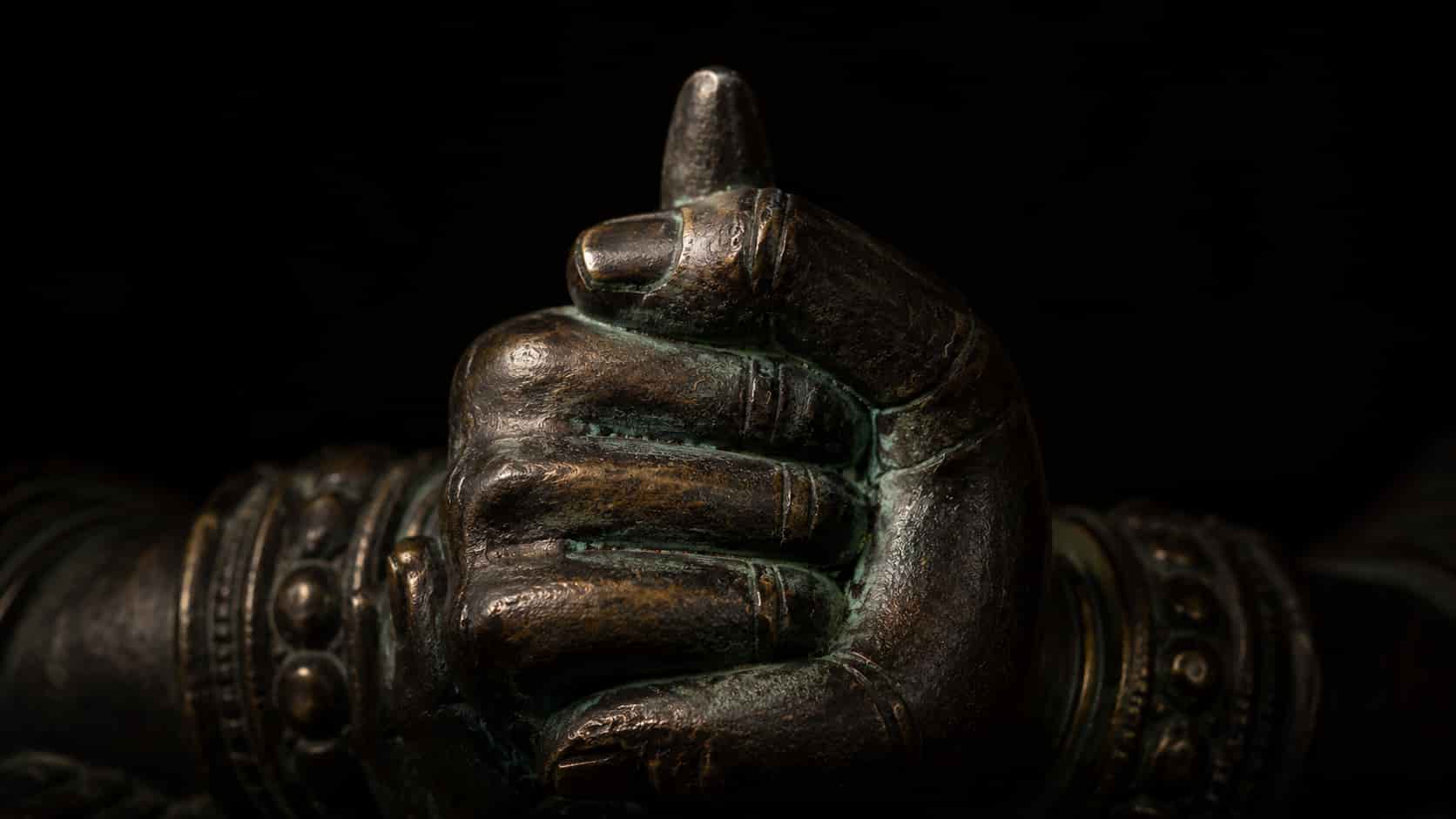
At the heart of Vajrayana tradition, the Vajra Mudra represents the indivisible union of wisdom and compassionate action, the two qualities that together define a fully awakened being.
- How to identify it: Right index finger extended upward and enclosed within the left fist, fingertip touching the left thumb.
- What it means: The union of skillful means (upaya) and wisdom (prajna); the indestructible, diamond-clear nature of enlightened reality.
- Where you see it: Japanese Shingon and Tibetan Vajrayana ritual practice; associated with Vairochana Buddha in esoteric Buddhist traditions.
How to Practice Buddhist Hand Signs in Meditation
To bring Buddhist hand signs into your own meditation, begin by choosing a mudra whose meaning aligns with your intention for the session, then sit in a stable and comfortable posture, form the mudra gently without forcing your fingers into tension, rest your awareness on the sensation in your hands as an anchor for attention, and hold the gesture throughout the session with ease, releasing and re-forming it whenever your hands grow tired, remembering that the gesture supports the quality of your mind rather than replacing it.
Research in embodied cognition, a field within cognitive science recognized by the Association for Psychological Science, supports the understanding that deliberate physical postures and gestures can measurably influence mental states and attentional focus, aligning with what Buddhist teachers have observed about mudra practice over centuries of training.
Step-by-Step Guide to Using Mudras in Your Meditation Practice:
Step 1: Choose a mudra aligned with your session’s intention. Dhyana for stillness, Anjali for gratitude, Abhaya for releasing anxiety or fear.
Step 2: Sit in a stable, comfortable posture, either on a meditation cushion or in a chair, with your back gently upright.
Step 3: Form the mudra gently, without straining your fingers, wrists, or arms.
Step 4: Rest your awareness on the physical sensation of your hands as one of your primary anchors of attention.
Step 5: Maintain the mudra throughout the session. If your hands grow tired or heavy, release them briefly and re-form the gesture when you are ready.
Best Mudras for Beginners:
Three mudras stand out for those new to working with Buddhist hand signs in meditation, each accessible and clearly meaningful.
The Dhyana Mudra (both hands resting in the lap, thumbs lightly touching) supports general sitting meditation and a quality of mental completion.
The Anjali Mudra (palms pressed together at the heart) works naturally as an opening and closing gesture that marks the transition into practice.
The Abhaya Mudra (right hand raised with the palm facing outward) can serve as a grounding gesture at the start of a session to release tension and invite a sense of protection and calm.
Final Thoughts
Buddhist hand signs are not decorative details on ancient statues. They are a living, layered language developed over 2,500 years to communicate the qualities, teachings, and transformative story of the Buddha.
Whether you encounter mudras in a temple, a museum, or on your own meditation cushion, understanding what each gesture means can change the entire experience of engagement.
You are no longer looking at art. You are reading a text written in the language of the hands.
Start with one mudra that resonates with you, learn its story, and bring it into your practice. That is how a symbol becomes something real.