It’s easy to get caught up in daily life and ignore the signals your body sends. Over time, stress and tension build quietly, leaving you feeling tight, tired, and out of sync with how your body actually feels.
Somatic yoga works differently. It asks you to slow down, pay attention, and move from the inside out. It is not about flexibility or performance. It is about connection.
This guide covers what somatic yoga is, how it differs from regular yoga, its key benefits, beginner exercises, and how to build a simple practice at home.
What Is Somatic Yoga?
Somatic yoga is a slow, body-awareness practice that combines gentle movement, breath, and internal focus to help you reconnect with how your body feels from the inside.
The word “somatic” comes from the Greek soma, meaning “body,” and the practice is rooted in the work of neurophysiologist Thomas Hanna, who developed somatic movement therapy in the 1970s to help people retrain movement patterns stored in the nervous system.
Unlike most exercises, somatic yoga is not about looking a certain way or reaching a specific range of motion. It is about noticing, feeling, and releasing. You move slowly and with full attention so the nervous system can actually register what is changing.
Somatic Yoga vs Regular Yoga: Key Differences
Both somatic yoga and regular yoga use movement and breath, but they serve very different goals. Here is a clear look at how they compare, so you can decide which one fits where you are right now.
| Feature | Somatic Yoga | Regular Yoga |
|---|---|---|
| Primary Focus | Internal sensation and nervous system awareness | External alignment, form, and posture |
| Pace | Slow and exploratory | Structured and sequential |
| Main Goal | Release tension, reset the nervous system | Build strength, flexibility, and fitness |
| Beginner Friendliness | Very accessible, no prior experience needed | Varies widely by style |
| Breath Role | Central to every movement | Guided but often secondary |
| Measurable Output | How you feel internally | How far you stretch or how long you hold |
Benefits of Somatic Yoga
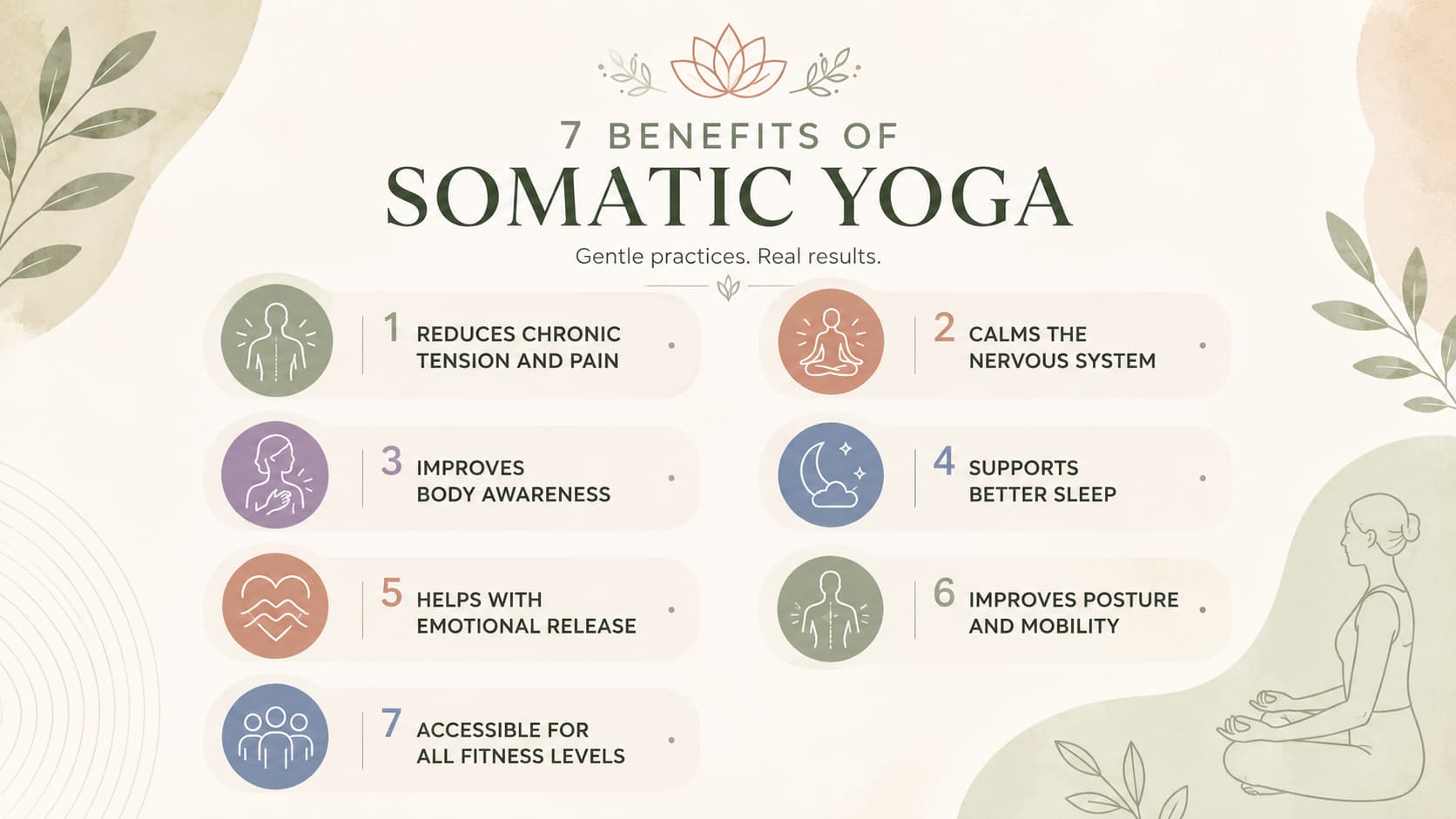
Somatic yoga offers more than just relaxation. When you practice regularly, you start to notice real shifts, both in your body and in how you move through daily life. Here is what the practice actually does for you.
- Reduces chronic tension and pain. Somatic yoga retrains the nervous system to release held tension, particularly in the neck, back, and hips, by slowly moving through patterns the body has locked into over time.
- Calms the nervous system. Slow, intentional movement signals safety to the body, shifting you out of a stress response and into a more relaxed, regulated state.
- Improves body awareness. You learn to notice where you unconsciously hold tightness, and that awareness alone often changes how you sit, stand, and move throughout the day.
- Supports better sleep. A calm nervous system makes it easier to fall and stay asleep, and a consistent evening somatic practice can improve sleep quality over time.
- Helps with emotional release. Tension and emotion are often stored in the body, and gentle somatic movement can help surface and release feelings held in the tissues.
- Improves posture and mobility. By addressing the movement patterns behind poor posture, somatic yoga targets the root cause rather than just the symptom.
- Accessible for all fitness levels. You do not need flexibility, strength, or prior experience. You just need a quiet space and a willingness to pay attention.
Is Somatic Yoga Good for Weight Loss?
Somatic yoga is not a high-calorie-burn workout, and it will not replace cardio or strength training for fat loss, but it can support weight loss indirectly by reducing the chronic stress that raises cortisol levels in the body.
High cortisol is directly linked to fat storage, particularly around the abdomen, according to research published in the journal Obesity.
By bringing the nervous system into a calmer state, somatic yoga may help regulate cortisol levels, improve sleep quality (which affects hunger hormones such as leptin and ghrelin), and reduce stress-driven overeating.
It works best as a recovery and stress-management tool alongside more active movement, rather than as a standalone weight-loss method.
Practices like embody yoga, which also focuses on internal body awareness, can complement this same approach.
Somatic Yoga Exercises for Beginners
You do not need special equipment or a studio to start. These five exercises are simple enough for a first session and effective enough to keep using over the long term. The one rule: move slowly. Slower than you think is necessary.
1. Somatic Body Scan
Video Credit: Somawise Healing Lab
This is the foundation of somatic practice. Before you move, you learn to listen. It helps build awareness of patterns of tension that often go unnoticed during daily life.
Steps:
- Lie flat or sit upright on your back on a mat or soft surface.
- Close your eyes and take three slow breaths.
- Starting at your feet, bring your attention to each part of your body as you move upward.
- Do not try to change anything. Just notice what you feel, where there is tension, and where there is ease.
- Spend 5 to 8 minutes doing this before any other somatic movement.
2. Pelvic Tilts with Awareness
Video Credit: Baptist Health
One of the best somatic yoga movements for lower back tension and hip tightness. The goal is not to stretch harder, but to notice how your pelvis and spine naturally move together.
Steps:
- Lie on your back with your knees bent and feet flat on the floor.
- Slowly tilt your pelvis forward so your lower back arches slightly away from the floor.
- Then tilt it back so your lower back presses gently into the floor.
- Move only as far as feels completely easy. Stop at the edge of effort, not past it.
- Pause between each direction and notice what shifts in your hips, back, and belly.
- Repeat 6 to 8 times slowly.
3. Slow Neck Side Rolls
Video Credit: Coury & Buehler Physical Therapy
Most people carry more tension in their neck than they realize. This exercise helps release built-up stiffness while improving awareness of how the neck moves.
Steps:
- Lie on your back or sit upright with your spine supported.
- Very slowly turn your head to the right.
- Stop when you feel a light pull. Do not push past it.
- Breathe in slowly, then breathe out and see if the tension softens even slightly.
- Slowly return to center. Pause.
- Repeat on the left side.
- Do 4 to 5 rounds on each side.
4. Somatic Cat-Cow
Video Credit: Di Hickman
A much slower, more inward version of the classic yoga movement. It encourages gentle spinal mobility while helping you tune into subtle sensations along the back.
Steps:
- Start on all fours with your hands under your shoulders and knees under your hips.
- On an inhale, let your belly drop slowly toward the floor as your head lifts gently.
- On an exhale, round your spine slowly upward and let your head drop.
- Move at half the speed you would normally use.
- Close your eyes if comfortable and focus entirely on what you feel along your spine.
- Do 6 to 10 rounds.
5. Somatic Breathing Exercise
Video Credit: Yoga With Adriene
This is both a technique and a reset you can use any time of day. Slow, intentional breathing helps calm the nervous system and bring your attention back to the present moment.
Steps:
- Lie down or sit upright with one hand on your belly and one on your chest.
- Breathe in slowly through your nose for a count of four.
- Breathe out slowly through your mouth for a count of six.
- Notice which hand rises more. Aim for the belly hand to rise on the inhale.
- Do 8 to 10 full breath cycles.
Who Should Try Somatic Yoga?
Somatic yoga is one of the most inclusive movement practices available. It asks very little of the body and a lot of the mind, which makes it useful for a wide range of people in different situations.
- Complete beginners who have never done yoga or any structured movement practice will find it approachable and pressure-free.
- People with chronic pain in the back, neck, or hips often benefit most, as somatic yoga targets the nervous system patterns behind recurring tension.
- Anyone dealing with high stress or burnout can use this practice to bring the body back to a calmer baseline without physical strain.
- Older adults looking for gentle movement that does not put pressure on the joints will find somatic yoga safe and well-suited to their needs.
- People recovering from injury can use somatic yoga as a gentle re-entry into movement, ideally with medical clearance from a physiotherapist or doctor.
- Athletes and active individuals can use it as a recovery tool to release tension built up from intense training.
If you have a serious medical condition, speak with your doctor before starting any new movement practice.
How to Build a Somatic Yoga Routine at Home
Building a somatic yoga routine at home requires little time or equipment. Start with three sessions per week, each lasting 15 to 20 minutes, using the five exercises above in the order they are listed.
Begin every session with the body scan, so you arrive fully in your body before you start moving. Use the breathing exercise at the end to close the session and let the effects settle. As the practice starts to feel natural, increase each session to 30 minutes and add a fourth day.
Choose morning sessions if you want to start your day feeling grounded and less tense, or evening sessions if your goal is better sleep and nervous system recovery.
If you want guided support, YouTube channels like SomaYoga Institute offer free somatic yoga videos for beginners, and apps like Insight Timer include somatic-style movement sessions led by certified practitioners.
The most useful thing you can do is track how your body feels before and after each session in a notebook, using two or three sentences. This habit builds the body awareness that makes the practice work over time.
Conclusion
Somatic yoga offers a simple, low-pressure way to reconnect with your body and release the tension many people carry without realizing it.
The practice is intentionally slow, giving your nervous system time to settle, tight muscles a chance to relax, and body awareness room to develop.
Start with the five beginner exercises covered above and focus on consistency rather than intensity. Even a few sessions each week can help improve mobility, reduce stress, and create a greater sense of ease in everyday movement.
Over time, these small, mindful movements can lead to lasting changes in how your body feels and functions.